Advancing Workforce Mobility
Supplemental materials for the Education Design Lab grant application. Track 2: Skills Validation in Non-Traditional Pathways.
Workforce Solutions for North Central PA (Lead Applicant) • IARAEC • OpenCxMS Technologies • NPRC
Partnership Structure
Four partners with distinct, non-competing roles. No overlap. No conflict.
Workforce Solutions for North Central PA
Lead Applicant & STAR PipelinePublic entity with 6-county coverage. Refers STARs into the program. Provides workforce data and employment tracking. Grant funds flow through their entity.
NPRC (Northern PA Regional College)
First Licensed AI-SOG Training ProviderNon-exclusive license to deliver Level 1 and Level 2 certification. Hosts BattleStation training lab. Provides accredited delivery, student services, and outcome tracking.
IARAEC
Credential Quality & Publishing Partner5-pathway credential validation framework. Assessment design and quality standards. CTDL publishing to Credential Engine Registry. Independent quality assurance layer.
OpenCxMS Technologies, Inc.
Technology & Certification PartnerAI-SOG certification curriculum. CxMS platform. BattleStation technology. Provides all training materials, assessment instruments, and platform access.
NPRC Training License
NPRC receives a non-exclusive license to deliver AI-SOG certification training — making them the first institution in the country to offer an AI safety operator program.
What NPRC Gets
- • First-mover advantage in AI safety certification
- • Complete curriculum and lab materials
- • BattleStation training units (grant-funded)
- • Enrollment pipeline from Workforce Solutions
- • Continuing education revenue from recertification
Why Non-Exclusive
- • Franchise model requires national scale
- • Grant funders prefer replicable models
- • NPRC benefits from being first, not from blocking others
- • Other institutions can be licensed in other regions
JIT Workforce Pipeline
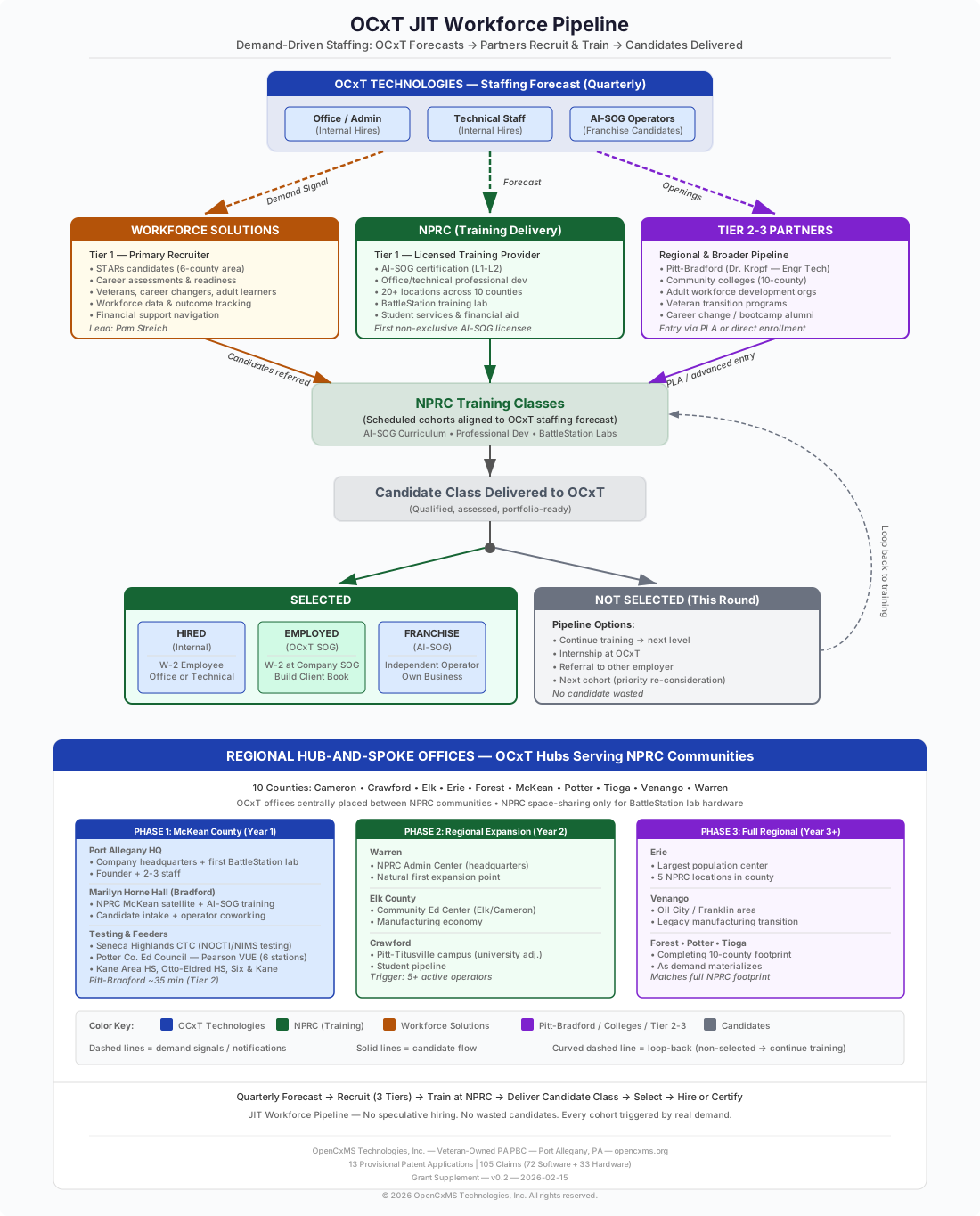
Demand-driven staffing. Every training cohort triggered by a real staffing forecast — not speculation.
How It Works
OCxT publishes a quarterly staffing forecast. Partners recruit and train candidates on a Just-In-Time schedule. Qualified candidates are delivered when positions open — not before, not after. No speculative hiring. No resume warehousing.
Forecast
OCxT signals quarterly staffing needs by category, headcount, and location
Recruit
Workforce Solutions sources STARs candidates from 6-county region
Train
NPRC delivers scheduled cohort training at campus locations
Deliver
Qualified candidate class delivered to OCxT for selection
Three-Tier Partner Pipeline
Candidates enter the pipeline at different points based on existing skills and credentials.
NPRC (training delivery, 10-county coverage, 20+ classroom locations) + Workforce Solutions (STARs recruitment, 6-county service area)
Entry: Pre-training. Candidates recruited and enrolled in NPRC programs.
Pitt-Bradford (engineering/technology programs, Dr. Matt Kropf) + community colleges (Penn College, Erie County CC)
Entry: Mid-pipeline. Graduates with existing credentials assessed via PLA for advanced placement.
Adult workforce development orgs, CareerLink offices, veteran transition programs, WEDnetPA training grants
Entry: Variable. Some candidates need more preparation; others bring transferable military/industry skills.
No Candidate Wasted
Every trainee builds toward value. Candidates not selected in one cohort are not discarded:
- • Continue training — advance skills for next cohort
- • OCxT SOG employment — W-2 at company-owned SOG location
- • Internship placement — gain experience at OCxT or partner orgs
- • Employer referral — matched to other employers in the region
- • Next cohort priority — first consideration for subsequent openings
Scheduling Model
Quarterly cycle aligned to OCxT growth:
- • Month 1 — OCxT publishes forecast (category, count, location, start date)
- • Month 2 — Workforce Solutions recruits; NPRC enrolls and begins training
- • Month 3 — Candidate class delivered; OCxT selects and onboards
First cohort: Q3 2026 (AI-SOG Level 1). Ongoing quarterly thereafter.
Four Staffing Paths
Office / Admin
W-2 employees. Office manager, admin, bookkeeper, training coordinator.
Source: Workforce Solutions referrals + local applicants
Technical Staff
W-2 employees. Platform engineers, SASM integration, QA, DevOps.
Source: Pitt-Bradford graduates + regional tech talent
SOG Employees
W-2 at OCxT-operated SOG locations. Certified operators delivering client services under the company brand.
Source: AI-SOG certified graduates • Build experience before franchise
Franchise Operators
Independent AI-SOG franchise candidates — certified operators who start their own business.
Source: All tiers — STARs, veterans, career changers, college graduates
Credential Pathways & Micro-Credentials
The AI-SOG certification exercises all five IARAEC credential pathways in a single, high-demand domain.
Five IARAEC Credential Pathways — All Exercised
The strongest possible proof-of-concept for the framework — one certification program that demonstrates every pathway.
Competency-Based Assessment
Each level has defined competencies co-created with employers. Certification exams measure real capability, not seat time.
Portfolio Evaluation
Operators build portfolios from real client engagements. CxMS audit trails document every deliverable — human-readable, version-controlled.
Micro-Credential Stacking
Individual certifications (CxMS Platform, BattleStation Ops, EU AI Act Compliance, SASM Safety) stack into level certifications.
Prior Learning Assessment
Experienced professionals and veterans receive credit for existing expertise. Military cybersecurity experience translates directly to accelerated entry.
Apprenticeship-to-Credential Conversion
Every level requires supervised engagements before advancement. Real work, real clients, real supervision — credential on completion.
Stackable Micro-Credentials
15 stackable micro-credentials mapped to IARAEC Pathway 3. Each is independently valuable; stacked together they compose level certifications.
AI-SOG Certified Operator Program
The nation's first professional certification for AI safety, compliance, and governance services.
Certification Architecture
A 4-level professional certification that trains individuals to deliver AI safety, compliance, and context architecture services to enterprise clients. Graduates work at OCxT-operated SOG locations to build experience, or enter the franchise network as independent business owners.
| Level | Title | Training Hours | Services Authorized | Technology Access |
|---|---|---|---|---|
| 1 | Operator | 40 hrs classroom + 20 hrs lab | Context Audit ($2.5K–$5K) | Cloud-based CxMS |
| 2 | Senior Operator | 60 hrs classroom + 40 hrs lab | Audit + Master Index ($7.5K–$15K) | BattleStation Lite |
| 3 | Team Lead | 40 hrs classroom + 60 hrs mentored | Enterprise Architecture ($25K–$75K) | BattleStation Standard |
| 4 | Ops Commander | 30 hrs classroom + 80 hrs practicum | All Services + Regional Ops | BattleStation Enterprise |
Operator
Entry-level certification. Open enrollment via NPRC or other licensed providers.
Module 1: Foundations of AI Safety & Governance
Module 2: CxMS Platform Fundamentals
Module 3: Context Audit Methodology
Module 4: Client Engagement & Professional Standards
Module 5: BattleStation Cloud Operations
Module 6: Ethics, Mission & Professional Standards
Module 7: Capstone: Supervised Client Engagement
Assessment: Written exam (70% pass) + 1 supervised engagement
Advancement: 3 supervised client engagements required
Senior Operator
Prerequisite: Level 1 + 3 completed engagements.
Module 1: Advanced CxMS Architecture
Module 2: BattleStation Lite Operations
Module 3: Enterprise Documentation & Deliverables
Module 4: ISO/IEC Safety Standards for AI
Module 5: Advanced Business Development
Module 6: Capstone: Independent Engagements & Portfolio
Assessment: Proficiency exam (75% pass) + portfolio review
Advancement: 6 total engagements (3 new independent)
Team Lead
Prerequisite: Level 2 + 6 completed engagements.
Module 1: Enterprise Context Architecture
Module 2: SASM Hardware Concepts
Module 3: Strike Team Leadership
Module 4: Multi-Stakeholder Engagement
Module 5: BattleStation Standard Operations
Module 6: Capstone: Team-Led Engagements
Assessment: Written + oral panel (80% pass)
Advancement: 12 total engagements (6 as team lead)
Operations Commander
Prerequisite: Level 3 + 12 engagements + business plan.
Module 1: Continuous Context Operations (CaaS)
Module 2: Franchise Territory Management
Module 3: Industry Vertical Specialization
Module 4: BattleStation Enterprise Operations
Module 5: Strategic Leadership & PBC Mission
Assessment: Case studies + oral board + business plan presentation
Maintenance: Annual recertification + CE credits
OCxT-Operated SOG Locations
Not every certified operator is ready to launch their own franchise on day one. OCxT will operate company-owned SOG (Safety & Operations Governance) offices where newly certified operators work as W-2 employees — delivering real client services, building experience, and earning steady income.
Earn While You Learn
W-2 employment at a company-owned SOG location. Steady paycheck, benefits, and supervised client work from day one after certification.
Build Your Client Book
Work real engagements under the OCxT brand. Build relationships, prove your skills, and develop a client base before going independent.
Franchise When Ready
When you're ready to own your business, spin off into your own AI-SOG franchise with clients, experience, and confidence already built.
Three paths after certification: Hired internally (office/technical W-2) • Employed at OCxT SOG location (operator W-2) • Independent franchise operator (own business). Every certified operator has a path — nobody is forced into business ownership before they're ready.
Headquarters & Operations
Port Allegany, McKean County, PA — ARC-eligible rural community in a PA Keystone Opportunity Zone.
Port Allegany, PA — Company Headquarters
OpenCxMS Technologies is headquartering at the Portage Industrial Properties site — the former Pittsburgh Corning glass block manufacturing plant at 4832 Route 155, Port Allegany. This 52-acre industrial campus sits in a PA Keystone Opportunity Zone, providing state sales tax and employment tax benefits.
Site
52 acres, 4 steel clear-span buildings (~28-31K sq ft), 14K sq ft nearly-new building available
Infrastructure
34.5 KV dedicated electrical, 125 GPM water well, natural gas, municipal sewer, 2,400-ft Norfolk Southern rail spur
Community Impact
Repurposing the site where 75 Pittsburgh Corning jobs were lost in 2016. Brownfield redevelopment in an ARC-eligible community.
Grant funds establish the initial office presence ($25K). Full facility buildout is funded separately through OCxT private capital and state/federal economic development programs (ARC POWER, PIDA, PA Industrial Sites Reuse, KOZ incentives). The grant seeds the local presence — the company investment makes it permanent.
Regional Hub-and-Spoke Offices
OCxT offices placed centrally between multiple NPRC campus communities — not 1:1 mapped. Each hub serves several surrounding training locations, maintaining OCxT's independent brand identity while staying accessible to the workforce pipeline.
Phase 1 — McKean Hub
Port Allegany HQ serves Bradford, Kane, Emporium, and Smethport NPRC communities (20-30 min radius). BattleStation lab at NPRC Bradford (space-share exception). Launch Q3 2026.
Phase 2 — Regional Hubs
Warren hub (serves Warren + Forest), Ridgway/St. Marys hub (serves Elk + Cameron), Coudersport hub (serves Potter + adjacent to Truck-Lite). Trigger-based, not calendar-based.
Phase 3 — Extended
Corry/Titusville hub (Erie + Crawford corridor), Erie metro, Oil City/Franklin. Opens only when operator and client demand justify presence.
NPRC space-sharing is the exception, not the rule — used only when hardware (BattleStation lab) must be physically where students train. OCxT maintains its own brand, hours, and client-facing identity at standalone locations.
Portage Industrial Properties — Campus Vision
The former Pittsburgh Corning site operated for 79 years as the last glass block manufacturing plant in the United States. After closing in 2016 and displacing 75 workers, the 500,000+ sq ft facility was demolished. What remains is a redeveloped 52-acre industrial campus with modern steel buildings, active rail infrastructure, and significant expansion capacity — positioned for its next chapter.
Site Specifications
- • 52.10 acres (main parcel) + 50+ acres across Route 155
- • 4 steel clear-span buildings (~28-31K sq ft total)
- • 14,000 sq ft building — nearly new, currently empty
- • 2,400-ft active rail spur (Norfolk Southern)
- • Two buildable flex areas for future expansion
- • Route 155 & Route 6 intersection access
Dedicated Infrastructure
- • 34.5 KV dedicated electrical line — heavy industrial capacity
- • 125 GPM water well — independent water supply
- • Natural gas (UGI Central Penn)
- • Municipal sewer & water — expandable
- • Allegheny River frontage (river parcel)
- • ~1,481 ft elevation
Keystone Opportunity Zone
PA KOZ designation provides state sales tax and employment tax benefits — reducing operating costs from day one.
ARC-Eligible
McKean County qualifies for Appalachian Regional Commission economic development funding — brownfield redevelopment in a manufacturing-transition economy.
Income-Producing
RecycALL glass recycling (25 tons/hr capacity) and rail siding lease to natural gas pipeline company — existing tenants offset carrying costs.
Phased Campus Development
Phase 1
Office + BattleStation Lab
2026-2027
Phase 2
SASM Prototyping + Assembly
2027-2028
Phase 3
Manufacturing + 25-40 Jobs
2028-2030
Phase 4+
Full Campus + Energy
2030+
The grant funds only the initial $25K office setup. Full campus development is funded separately through private capital, ARC POWER grants, PIDA loans, and KOZ tax incentives. This site is not a burden on the grant — it is the long-term infrastructure that makes the program permanent.
About OpenCxMS Technologies
Veteran-owned Pennsylvania Public Benefit Corporation. Port Allegany, PA.
Patent Portfolio
All inventions by Robert S. Briggs II, sole inventor. Filed as Small Entity with the USPTO. Priority dates: February 4–13, 2026.
Software Patents (9 PPAs, 72 Claims)
• Persistent AI Context Management
• Enterprise AI Deployment Platform
• AI Knowledge Architecture
• AI Consulting Methodology
• Structured AI System Evolution
• AI Context Usage Analytics
• Multi-Vendor AI Consensus Protocol
• Fleet Coordination Protocol
• Real-Time Safety Micro-Agents
Hardware Patents (4 PPAs, 33 Claims)
• Robot Brain Module (3 Form Factors)
• Dual-Brain Safety Architecture
• Manufacturing & QA Standards
• Tamper-Evident Safety Architecture
Standardized Autonomous Safety Module (SASM)
Hardware-enforced AI safety for robots. Dedicated safety processor, power gating, <10ms cutoff. No software override possible.
Open Source + Patents: The CxMS memory framework is open source (460+ GitHub users). The patents cover the safety and governance architecture built on top of it — both software and hardware.
Demonstrated AI Operating Experience
We don't just propose to build AI tools. We built this grant application with them. Over 85+ working sessions, OpenCxMS Technologies has operated advanced AI systems to produce real, verifiable deliverables.
AI-Assisted Patent Drafting
All patent applications drafted with AI assistance — prior art research, claims refinement, novelty gap identification. All inventive concepts originated with the founder.
AI-Assisted Curriculum Development
Complete 4-level AI-SOG certification curriculum developed with AI assistance — module design, assessment instruments, competency frameworks.
AI-Assisted Grant Application
This grant application was developed with AI assistance — narrative drafting, budget modeling, partner role design. This page itself was built using AI-augmented development.
AI-Assisted Technology Development
The CxMS framework, website, and enhancement specifications were all developed with AI assistance. The product that trains AI operators was built by an AI operator.
Dogfooding: Our Safety Architecture Catches AI Bias
Every AI-assisted credential assessment is processed by multiple independent AI architectures simultaneously — the same patented Multi-Vendor Consensus Protocol we built for AI safety. When models disagree on a candidate's competency score, especially across demographic subgroups, the consensus layer flags the discrepancy for human review before any result is issued.
The entire chain — each model's output, the consensus result, and the human reviewer's decision — is logged in plain-text audit files anyone can read. No black boxes. The technology we built to make AI safe is the same technology we use to make credentialing fair.
Ethical AI Disclosure
OpenCxMS Technologies believes in transparency about AI usage:
- AI assisted, human directed. All inventive concepts, strategic decisions, and quality judgments are made by the founder.
- No misrepresentation. We do not present AI-generated content as purely human-created.
- Responsible AI principles. Transparency, auditability, human oversight, documented provenance — the same principles embedded in our products.
This page provides supplemental information for the Education Design Lab Advancing Workforce Mobility grant application (Track 2: Skills Validation in Non-Traditional Pathways). Patent applications referenced are provisional and subject to USPTO examination. Certification program details are v0.1 draft and subject to refinement during the grant period.