Your Robot Has a Brain. It Doesn't Have a Standard.
NVIDIA sells a proprietary brain for $3,499. Every robot manufacturer builds their own. Nobody has published an open standard that defines how robot brains should be shaped, how they connect to any robot body, and how they're kept safe.
The Standardized Autonomous Safety Module (SASM). The ATX standard for robot brains.
The Hardware Standard
In 1995, Intel published the ATX spec and unlocked a multi-billion-dollar ecosystem of interchangeable PC components. The SASM specification does the same for robot brains.
All three sizes share the same connector interface and mounting pattern. A smaller brain mounts in a chassis designed for a larger one. Every dimension, connector position, and thermal envelope defined to half-millimeter tolerances.
The Manufacturer Interface Module (MIM)
One brain, any robot. The MIM is a pluggable hardware adapter between the standardized brain and any manufacturer's robot body — like a PCIe slot for robotics.
Hardware-Enforced Safety
Every AI safety system today is software watching software. The SASM puts a hardware kill switch between the AI and the power supply.
Safe Torque Off for AI
In industrial automation, safety systems have had physical authority for decades — you don't ask a motor to please stop spinning; you cut its power. The SASM applies this proven principle to AI compute for the first time.
Multi-Vendor Consensus
Multiple AI models from different vendors must reach consensus before any physical action. If one AI hallucinates, the others catch it — the same diverse-redundancy principle that keeps Boeing 777 flight computers safe, applied to robot decision-making.
BattleStation: On-Premises AI Infrastructure
Cloud AI means cloud dependency. The BattleStation puts the entire AI inference stack on-premises — and then doubles it.
Three deployment tiers: Edge compute on the robot for latency-critical safety decisions. BattleStation on-premises for full consensus. Cloud optional for enrichment — never required for operation.
The Problem Nobody Solved
Every major robotics company is building faster brains. Nobody is building inspectable memory.
| Company | How Robot "Remembers" | Can a Human Read It? |
|---|---|---|
| NVIDIA (Thor T5000) | $3,499 proprietary chip · vector embeddings | No — need NVIDIA tools to decode |
| Google (Gemini 3) | 1M-token context window | No — volatile, gone on restart |
| Tesla (Optimus) | Fleet learns centrally, individuals don't | No — no per-robot memory |
| Boston Dynamics | Inherits Gemini's approach | No — same volatility |
| Figure AI | CEO says "persistent memory will be commonplace" | Not shipped yet |
Think of it this way:
Every robot today has ROM and RAM. None of them have SSD. We designed the SSD layer.
Persistent AI Memory Architecture
We didn't just design storage. We designed a retrieval architecture that gets smarter and cheaper over time.
Tag-Based Persistent Memory
Every memory tagged with semantic labels. Retrieval by meaning, not keyword matching or vector similarity. A robot remembers "obstacle detected in loading dock B" — not [-0.445, 0.667, -0.334...].
Closed-Loop Retrieval
The same AI that retrieves memories is the one that uses them. No middleman embedding model. No retrieval-generation mismatch. The system that searches is the system that acts — eliminating an entire class of errors.
Multi-Vendor Consensus Memory
9 independent AI models agree on what memories are relevant before retrieval completes. Hallucinated associations filtered by cross-vendor disagreement. The same diverse-redundancy principle from our safety architecture, applied to memory itself.
Semantic CDN
Tag expansion results cached locally — like a CDN caches web content, but for semantic associations. As the system learns its operational vocabulary, memory lookup cost approaches zero. Week one: learning. Month two: near-instant recall.
The result: A robot that remembers what it learned, retrieves by meaning, validates through consensus, and gets faster the longer it runs — all in files a human can read.
What "Readable Memory" Looks Like
Our approach:
# Safety Assessment: Proposal 000041

## Decision: APPROVE

## Checks Performed
- [x] Zone 3 proximity sensors clear
- [x] No human presence detected
- [x] Speed within zone limit (40% < 60%)
- [x] Force within safety limit (15N < 25N)

## Risk Assessment
LOW - All parameters within normal range.
A shift supervisor can read this. A regulator can read this. No special tools.
NVIDIA's approach:
[0.234, -0.891, 0.445, 0.112,
 -0.667, 0.334, 0.778, -0.223,
 0.556, -0.112, 0.889, 0.001,
 -0.445, 0.667, -0.334, 0.998,
 0.223, -0.556, 0.112, -0.889,
 ...]

// 768-dimensional vector embedding
// Requires NVIDIA tools to decode
Try explaining this to OSHA.
Fleet Distributed Memory
One robot learns. The whole fleet remembers. Every piece of data tracked back to where it came from.
Shared Storage
Robots share memory across the fleet. What one robot learns about a loading dock, every robot in the facility can access. No re-learning. No redundant mistakes.
Provenance Tracking
Data always attributed to its origin robot, regardless of who's carrying or transmitting it. When a regulator asks "which robot generated this data?" — the answer is in the file.
Central Defragmentation
Central repository automatically defragments scattered data into per-robot archives. Streaming data arrives fragmented across the fleet — the system organizes it without manual intervention.
No competitor has this. Tesla's fleet learning is centralized and opaque. Our fleet memory is distributed, human-readable, and every byte traces back to its source. Compliance auditors can follow any piece of data from creation to consumption across the entire fleet.
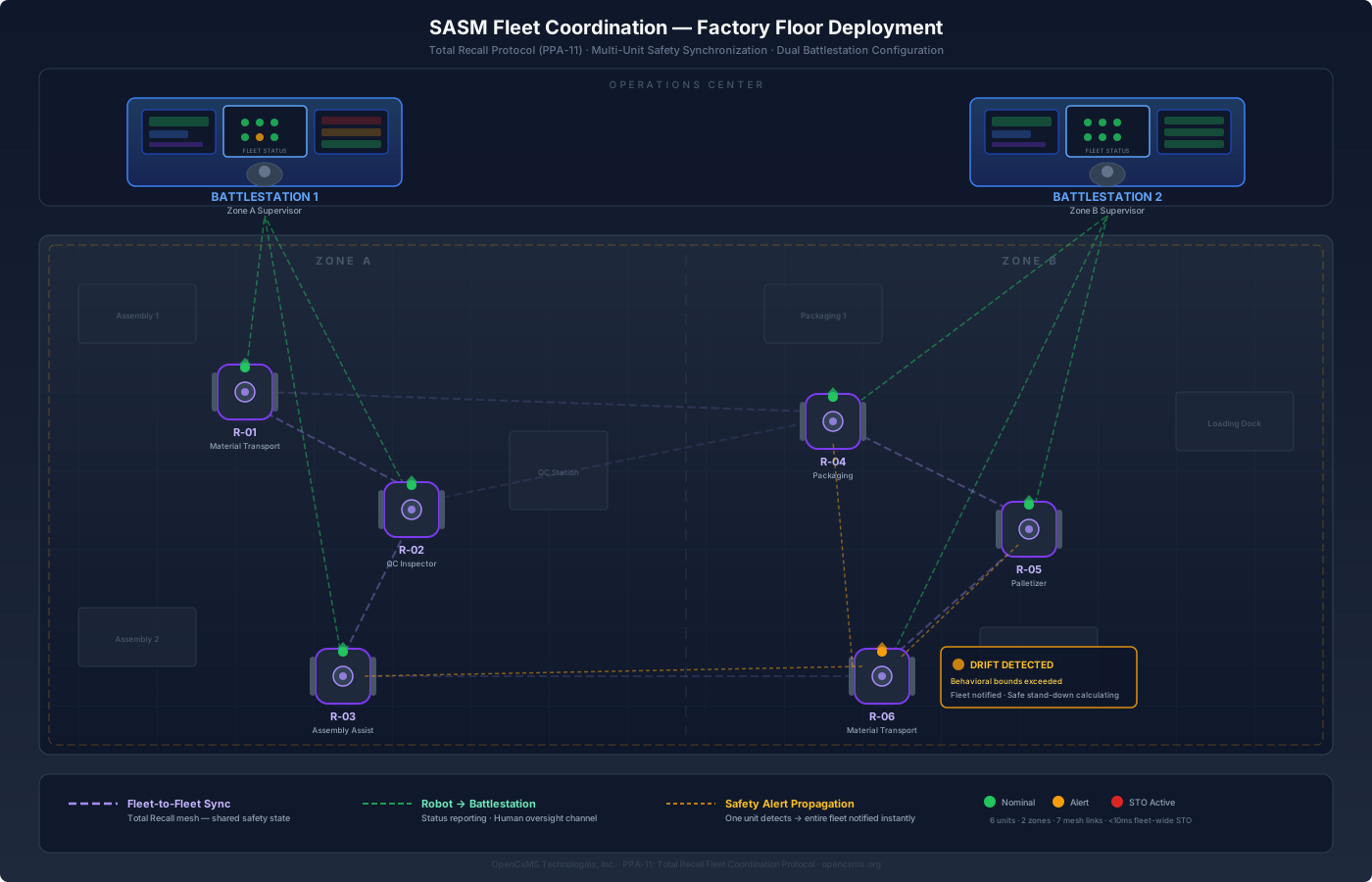
Fleet coordination on a factory floor — mesh communication, zone management, and real-time safety alert propagation
Why This Matters in August
The EU AI Act becomes fully applicable August 2, 2026.
Any robot deployed in the EU that makes autonomous decisions near humans must have:
Vector databases don't satisfy Article 13. Volatile context windows don't satisfy Article 12. The industry has a compliance gap with a hard deadline.
The SASM satisfies all three articles natively. Hardware-enforced safety for Article 14. Human-readable decision logs for Articles 12 and 13. Compliance isn't a layer bolted on after the fact — it's built into the architecture.
Calling Hardware & Manufacturing Partners
The EU AI Act takes effect in 6 months. Robot manufacturers shipping to Europe need hardware-enforced safety — not another software layer. The SASM specification is designed and patent-protected. Now it needs to be built.
Electronics Manufacturers
Safety-critical board design, power gating circuits, hardware interlock modules. Experience with IEC 61508, ISO 13849, or industrial safety systems.
Connector & Enclosure Firms
MIM connector prototyping, standardized form factor enclosures in three sizes. Sub-millimeter tolerance manufacturing.
Test & Certification Labs
Safety certification pathways for EU AI Act, CE marking, and functional safety standards. Pre-compliance testing for hardware safety modules.
13 provisional patents protect the architecture. Technical specifications available under NDA. We're looking for partners who want to build the standard — not just sell into it.
For Your Role
OEMs
- →Build to the SASM standard — any brain, any robot
- →Hardware safety out of the box
- →EU AI Act compliance built in
System Integrators
- →One standard across all vendors
- →MIM adapters for any platform
- →Auditable safety for regulated deployments
Fleet Operators
- →Know what every robot decided, and why
- →Swap brains without rewiring the robot
- →Regulatory docs generated automatically
IP Portfolio
Software Patents — 72 Claims
Hardware Patents — 33 Claims
Get Started
Technical specifications available under NDA.