What We're Engineering
Open specifications. Transparent timeline. The Standardized Autonomous Safety Module (SASM) — three form factors, one universal connector, hardware-enforced safety for autonomous robots.
The ATX standard for robot brains.
Three Form Factors
| Compact (100C) | Standard (100S) | Extended (100E) | |
|---|---|---|---|
| Dimensions | 100 × 70 × 30 mm | 150 × 100 × 40 mm | 200 × 150 × 50 mm |
| Size Reference | Deck of cards | Paperback book | Hardcover book |
| AI Compute Slots | Up to 2 partitions | Up to 3 partitions | Up to 6 partitions |
| Thermal Envelope | 25W (passive cooling) | 65W (optional forced air) | 150W (forced air or liquid) |
| Safety Processor | Yes — dedicated | Yes — dedicated | Yes — dedicated |
| Target Robots | Drones, companions, small mobile platforms | Quadrupeds, small humanoids, industrial cobots | Full-size humanoids, heavy industrial, autonomous vehicles |
All three tiers share: common MIM connector position, common primary mounting holes, common status indicator layout. A smaller brain fits in a larger chassis with a bracket adapter.
Safety Architecture
Every tier. Every form factor. Hardware-enforced safety that the AI cannot override.
Safety Processor
Dedicated SIL-rated MCU on its own power rail. Completely independent of the AI processors it monitors. Boots first, validates AI before power-on.
Power Gating
Hardware kill — cuts AI compute power in <10ms. Safe Torque Off applied to AI (IEC 61800-5-2 analog). The AI cannot prevent its own shutdown.
Multi-Vendor Consensus
Up to 9 AI models from 9 different vendors vote on every safety decision. Majority consensus allows motion. Dissenting opinions logged as training signal.
Immutable Audit Trail
Hash-chain logging on shared storage. Every decision recorded in human-readable files. Regulators can inspect without special tools. EU AI Act Articles 12, 13, 14 compliance by architecture.
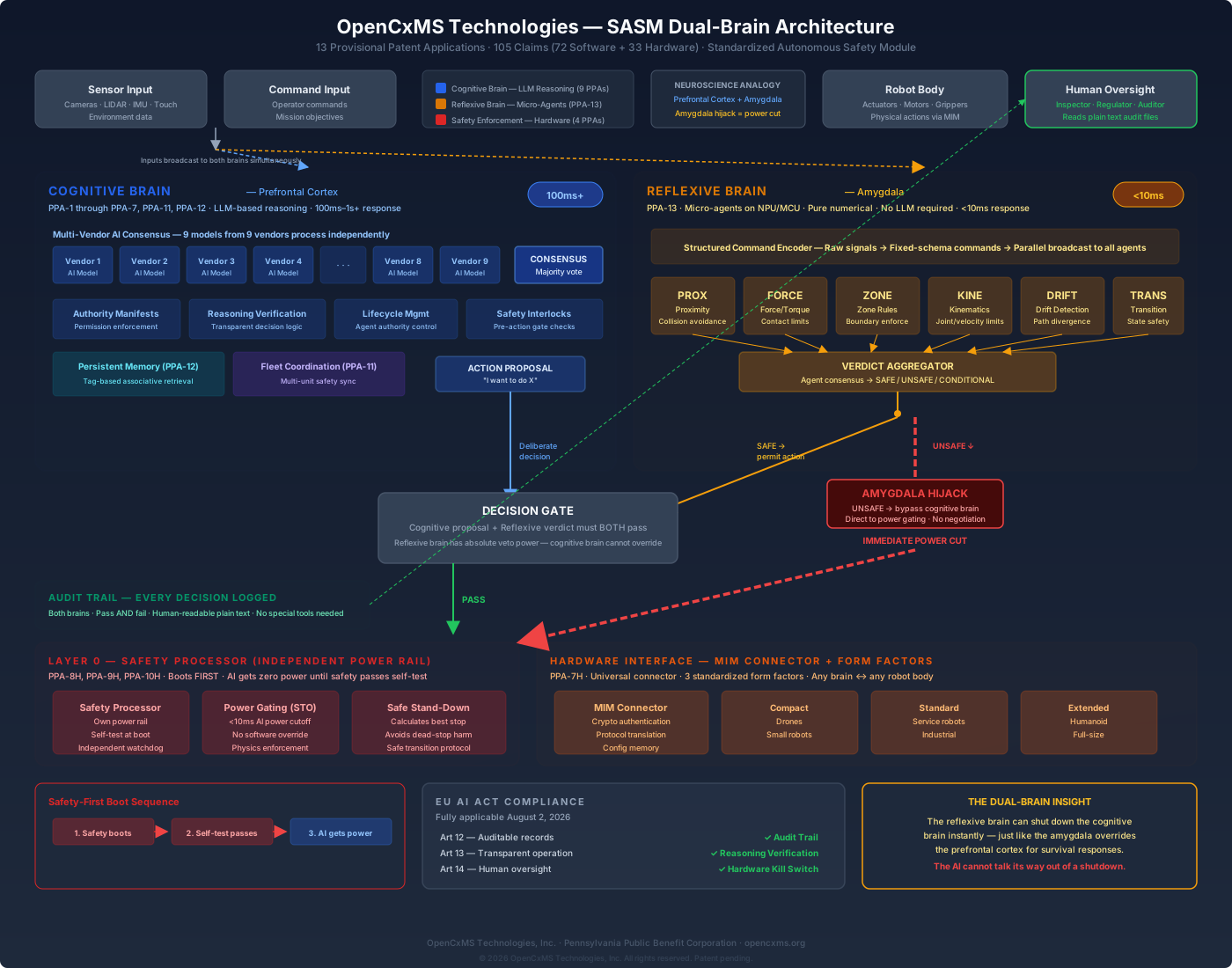
SASM Dual-Brain Architecture — cognitive reasoning + reflexive safety with hardware-enforced shutdown
Additional Safety Features
Certification Targets
| Standard | Target | What It Covers |
|---|---|---|
| IEC 61508 | SIL 2 (path to SIL 3) | Functional safety — the core rating |
| ISO 13849 | PL d (path to PL e) | Machinery safety control systems |
| ISO 10218 | Compliance | Industrial robot safety |
| ISO/TS 15066 | Compliance | Collaborative robot (cobot) safety |
| IEC 62443 | Compliance | Industrial cybersecurity (MIM crypto auth) |
| EU AI Act | Full compliance | Articles 6, 9, 12, 13, 14 — effective Aug 2, 2026 |
| UL 4600 | Evaluation | Autonomous product safety |
Engineering Milestones
Month-by-month timeline from specification to reference design. March 2026 → February 2027.
What Makes This Different
| Traditional AI Safety | SASM |
|---|---|
| Software tells AI to stop | Hardware cuts AI's power |
| Single AI checks itself | 9 AIs from 9 vendors vote |
| Trust the model | Trust the physics |
| No standard — every robot is custom | ATX-like standard — any brain, any robot |
| Compliance by policy | Compliance by architecture |
| Audit by log review | Audit by immutable hash chain |
Request Technical Briefing
Full technical specifications available under NDA. 15 provisional patents, 134 claims, complete architecture documentation.